
How many cameras can a 24 port PoE switch run?
It depends on the total power budget, not the port count. A 370W budget typically runs 24 standard domes, but far fewer PTZ or heated units — we calculate it from your model list.
Power over Ethernet
Overview
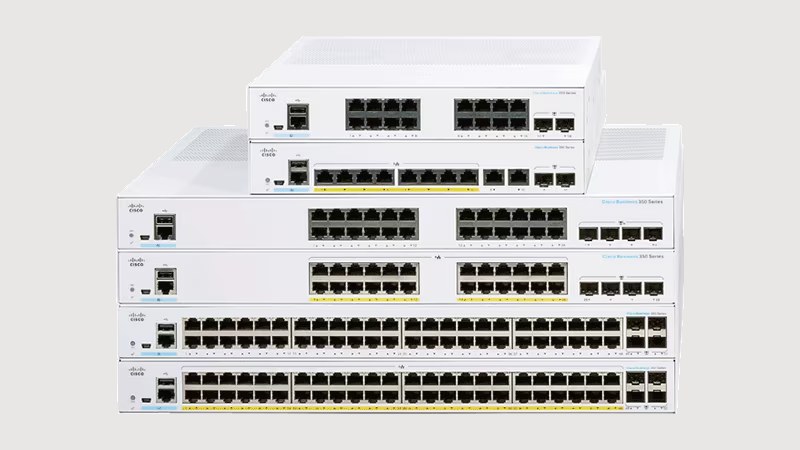
Power over Ethernet removes a socket from every camera, phone and access point you install. We supply PoE, PoE+ and PoE++ switches and PoE hubs from 8 to 48 ports, sized against the devices they will actually power rather than the headline port count.
poe switch
poe hub
48 port poe switch
poe switch for ip camera
Older IP phones run happily on 15.4W 802.3af. Modern Wi-Fi 6 and Wi-Fi 6E access points and PTZ cameras need PoE+ or PoE++ to run at full capability, and will quietly throttle features if underfed.
Where one camera or access point sits away from a switch, a PoE injector or a small PoE hub is cheaper and tidier than pulling power. We also supply PoE extenders for runs beyond 100 metres and outdoor-rated units for gate and car park cameras.
Surveillance loads are constant, not bursty, so a switch running near its power ceiling will stay there. We leave at least 25 per cent headroom, isolate cameras on their own VLAN, and specify a UPS on the switch so cameras stay up through a power event.
FAQs
It depends on the total power budget, not the port count. A 370W budget typically runs 24 standard domes, but far fewer PTZ or heated units — we calculate it from your model list.
A PoE hub or injector simply adds power to an existing link. A PoE switch both switches traffic and powers devices, and gives you VLANs and management as well.
A PoE (Power over Ethernet) switch is a network switch that delivers electrical power alongside data over the same Ethernet cable. It lets you run devices like IP cameras, wireless access points, VoIP phones and door controllers without a separate power supply at each device — one cable does both jobs.
The switch itself plugs into the mains like any other switch — that is where the power it passes to devices comes from. What it removes is the need for a power supply at each connected device. For critical sites we pair the switch with a UPS so cameras and phones stay up through a power cut.
Yes. PoE switches negotiate power only with devices that ask for it, so a laptop, printer or PC plugged into a PoE port works exactly as it would on a normal switch. You can mix powered and non-powered devices on the same switch freely.
No. Many switches are data-only, and some ranges offer the same model with and without PoE. Check for PoE, PoE+ (up to 30W per port) or PoE++ (up to 60–90W) in the specification, and tell us what you are powering so we quote the right variant and power budget.
Get a Quote
Send the models, quantities and site details and we will come back with availability, lead time and a tailored quote.
PoE, PoE+ and PoE++ switches and PoE hubs sized against your real device load. 8, 16, 24 and 48 port models for IP cameras, access points and IP phones.